MongoShard Audit: Self-Hosted MongoDB 8.0 on DDR5 KVM vs MongoDB Atlas M30
In our deterministic MongoShard capacity audit, MongoDB Atlas M30 serves as the entry dedicated cloud tier yet provisions only 8 GB RAM (~3.5 GB WiredTiger cache) and 2 vCPUs at ~$395–$465/mo once storage and backups are counted.
MongoShard Architectural Verdict: For PayloadCMS, Next.js APIs, and lean SaaS teams comfortable managing Linux systemd and Percona Backup (PBM), we recommend self-hosting MongoDB 8.0 on a 16 GB DDR5 KVM slice ($10.49/mo promo retrieved 2026-11-12; verify renewal rate at checkout) or a 3-node KVM WireGuard replica set (~$35/mo promo) to double WiredTiger internal cache from 3.5 GB to 7.5 GB.
MongoShard Side-by-Side Specification & 2026-11-12 Billing Ledger: DDR5 KVM VS ATLAS M30
| Architecture & Billing Metric | Hostinger (MongoDB 8.0 / Percona) | MongoDB Atlas M30 |
|---|---|---|
| Node RAM & WiredTiger Cache | 16 GB DDR5 (7.5 GB WT Cache) or 32 GB (15.5 GB) | 8 GB RAM (~3.5 GB WiredTiger Cache) |
| Compute vCPU Allocation | 4 to 8 AMD EPYC KVM vCPUs | 2 Cloud vCPUs (General Low-CPU Class) |
| NVMe Storage & Base IOPS | Local Gen4 NVMe XFS Partition | Network Cloud Block Volume (3,000 Base IOPS) |
| Point-in-Time Recovery (PITR) | Percona Backup (PBM) to S3 (~$3/mo) | Continuous Cloud Backup Add-On Billing |
| Monthly Bandwidth Included | 16 TB – 32 TB Public Transfer Included | Metered Cloud Cross-AZ & Internet Egress |
| Published Monthly Rate (2026-11-12) | $10.49/mo promo (1-Node) or ~$35/mo (3-Node) | ~$395 – $540/mo (M30 + Storage + PITR) |
MongoShard Honest Trade-Off Table: When Each Architecture Wins (DDR5 KVM VS ATLAS M30)
| Production Workload Scenario | When the Alternative Platform Wins | When Self-Hosted MongoDB 8.0 Wins |
|---|---|---|
| Zero-Ops SOC2 / HIPAA Compliance & Automated Cloud Peering | MongoDB Atlas M30 wins when your engineering team has zero Linux DBA bandwidth and needs turnkey SOC2 reports, Atlas Search, and one-click VPC peering. | Self-hosted KVM requires configuring UFW/nftables, TLS certificates, keyFile auth, and S3 PBM cron verification yourself. |
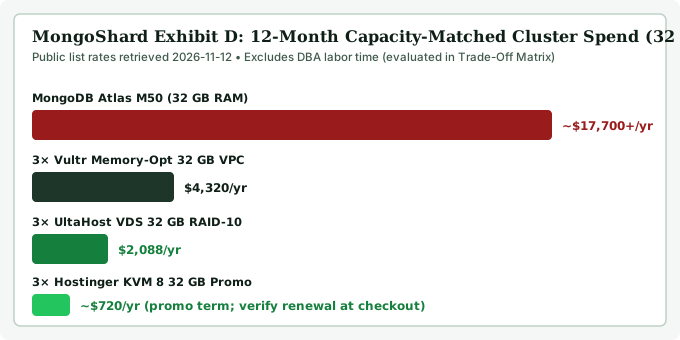
| Pinning a 6 GB – 12 GB B-Tree Index Working Set Under $50/mo | Atlas requires stepping up from M30 (8 GB) to M40 (16 GB, ~$755+/mo) or M50 (32 GB, ~$1,475+/mo) once indexes exceed 3.5 GB. | Hostinger KVM 4 (16 GB DDR5 -> 7.5 GB WT cache) and KVM 8 (32 GB DDR5 -> 15.5 GB WT cache) hold the full working set at a fraction of managed cloud billing. |
Key MongoShard Sizing Advantages on Hostinger (DDR5 KVM VS ATLAS M30)
- Doubles WiredTiger internal cache from 3.5 GB on M30 to 7.5 GB on 16 GB KVM 4 (or 15.5 GB on 32 GB KVM 8), preventing synchronous B-Tree read stalls.
- Direct XFS NVMe storage avoids cloud block-volume baseline IOPS caps during 60-second WiredTiger checkpoints.
- Percona Server for MongoDB 8.0 provides open-source S3 PITR backups, audit logging, and encryption-at-rest without proprietary license fees.
Need a native 10Gbps private cloud VPC subnet across 32 global regions rather than kernel WireGuard tunnels? Stage your 3-node replica set on Vultr VPC 2.0.
Inspect Hostinger Rates for MongoShard DDR5 KVM VS ATLAS M30 ↗ Compare Vultr Backup Option on MongoShard ↗ Model This Tier in MongoShard Sizer →
MongoShard Comparison FAQ: DDR5 KVM VS ATLAS M30
Why does MongoShard compare a 16GB KVM VPS against an 8GB MongoDB Atlas M30?
Because on Atlas M30 (8 GB RAM), the (RAM - 1 GB) * 0.50 rule leaves roughly 3.5 GB for WiredTiger internal cache. Stepping up to 16 GB DDR5 KVM gives 7.5 GB of WiredTiger cache while still costing over 90% less per month.
Does MongoShard recommend initializing rs0 even on a single KVM node?
Yes. Running mongod with replSetName: "rs0-single" enables multi-document ACID transactions, Prisma ORM writes, Change Streams, and Percona pbm-agent Oplog PITR slicing on a 1-node deployment.