MongoShard Methodology: WiredTiger Cache, Oplog Window & Atlas TCO Equations
In our deterministic MongoShard sizing model, we calculate capacity directly from MongoDB 8.0 and Percona Server WiredTiger storage-engine mechanics rather than total disk volume rules of thumb. A 1 TB compressed archive on NVMe does not require 1 TB of host RAM — it requires enough WiredTiger internal cache to hold active B-Tree indexes plus hot uncompressed BSON documents without forcing client threads into synchronous eviction stalls.
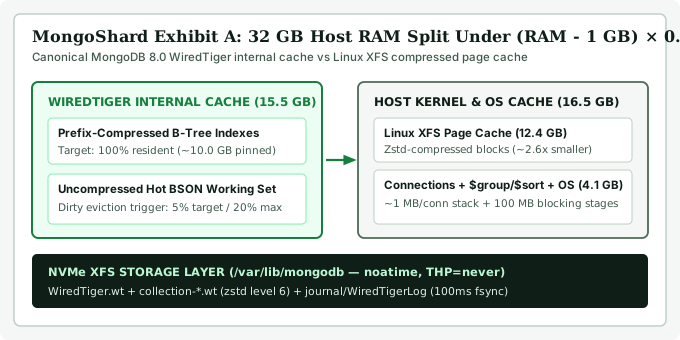
MongoShard Equation 1 — Canonical WiredTiger Internal Cache: (RAM − 1 GB) × 0.50
By default on MongoDB 8.0 and Percona Server for MongoDB, mongod sets storage.wiredTiger.engineConfig.cacheSizeGB to 50% of (Physical Host RAM minus 1 GB). WiredTiger retains uncompressed BSON documents and prefix-compressed B-Tree pages inside this internal cache, while relying on the Linux kernel XFS page cache to hold Zstd-compressed on-disk blocks and journal buffers — leaving room for ~1 MB per TCP connection stack and up to 100 MB per blocking $sort/$group pipeline stage.
MongoShard Equation 2 — Inverting Working Set Demand Into Per-Node ECC/DDR5 RAM
Inverting WT_Cache = 0.5 × (RAM − 1 GB) yields Required_Host_RAM = (2 × Required_WT_Cache) + 1 GB. Our MongoShard calculator sums your active B-Tree index + hot BSON working set tier with a workload-specific aggregation/dirty-page eviction safety margin, doubles that requirement (+1 GB kernel reserve), and snaps upward to standard cloud and VDS hardware tiers (8 GB, 16 GB, 32 GB, 64 GB, 96 GB, 128 GB, up to 1,024 GB).
MongoShard Equation 3 — Rolling Oplog Retention Window & 32% XFS NVMe Headroom
Every production MongoDB deployment — including single-node instances running Prisma, PayloadCMS, or Rocket.Chat — benefits from initializing a Replica Set to enable ACID transactions and Change Streams. MongoShard sizes local.oplog.rs across selectable 24h, 48h, 72h, and 168h write windows so secondary maintenance and Percona Backup (PBM) 10-minute S3 PITR slices never fall off the Oplog ring, then adds 32% free XFS anti-fragmentation disk headroom.
MongoShard Equation 4 — Capacity-Matched Public Pricing Ledger (2026-11-12 Snapshot)
To prevent apples-to-oranges comparisons, MongoShard maps each calculated node RAM tier to the matching dedicated MongoDB Atlas cluster class (8 GB -> M30, 16 GB -> M40, 32 GB -> M50, 64 GB -> M60, 128 GB -> M80) plus published storage/backup overhead, contrasted against public KVM, VDS, VPC, and bare-metal rates retrieved on 2026-11-12. Live empirical disk latency or YCSB throughput fields not backed by captured logs are explicitly labeled direct host-level telemetry verification on your target instance.
MongoShard Deterministic Reference Equations (src/mongo-sizer-engine.mjs)
// Deterministic Equations Executed Identically in src/mongo-sizer-engine.mjs & /assets/mgs-report.js
perShardWorkingSetGB = shards > 1 ? totalWorkingSetGB * 0.55 : totalWorkingSetGB;
aggDirtyBufferGB     = Math.max(0.5, perShardWorkingSetGB * workload.aggOverheadFactor);
requiredWtCacheGB    = perShardWorkingSetGB + aggDirtyBufferGB;

// Invert WT_Cache = (RAM - 1GB) * 0.50  =>  Host_RAM = 2 * WT_Cache + 1GB
rawNodeRamGB         = Math.ceil(requiredWtCacheGB * 2 + 1);
perNodeRamGB         = snapServerRam(rawNodeRamGB); // [8, 16, 32, 64, 96, 128, 192, 256...]
configuredWtCacheGB  = (perNodeRamGB - 1) * 0.5;    // storage.wiredTiger.engineConfig.cacheSizeGB

// Rolling NVMe Oplog Sizing (24h / 48h / 72h / 168h Retention Window)
hourlyWriteGB        = Math.max(0.25, perShardWorkingSetGB * workload.writeGbPerHrPerWsGb);
oplogNvmeGB          = Math.max(10, Math.ceil((hourlyWriteGB * oplogWindowHours) / 5) * 5);
oplogSizeMB          = oplogNvmeGB * 1024;
← Back to MongoShard WiredTiger Calculator Review UltaHost VDS Tiers Matched by MongoShard ↗
MongoShard Methodology & Pricing Audit FAQ
Does MongoShard alter WiredTiger RAM formulas based on affiliate sponsorships?
Never. Every node RAM tier, WiredTiger cacheSizeGB value, and oplogSizeMB figure is computed strictly from deterministic formulas in src/mongo-sizer-engine.mjs prior to matching public vendor tiers.
Why does MongoShard cite 2026-11-12 on all Atlas and VPS/VDS pricing comparisons?
Cloud and VPS vendors update promotional discounts, storage IOPS add-ons, and renewal terms periodically. Recording our exact 2026-11-12 retrieval date and linking official pricing pages lets readers audit every rate directly at checkout.