MongoShard Report: MongoDB 8.0 WiredTiger (RAM − 1 GB) × 0.50 & 3-Node Replica Set Economics
In our deterministic MongoShard engineering report, we model MongoDB 8.0 and Percona Server capacity directly from WiredTiger storage internals: pinning 100% of active B-Tree indexes plus hot uncompressed BSON inside 50% × (RAM − 1 GB), sizing 48h–72h rolling Oplog rings on XFS NVMe, and auditing 3-node P-S-S cluster TCO against MongoDB Atlas M30–M60.
MongoShard Executive Summary: An 800 GB Zstd-compressed MongoDB collection on disk does not require 800 GB of RAM — yet if active B-Tree indexes plus hot BSON documents reach 12 GB, we recommend a 32 GB RAM node (15.5 GB WiredTiger internal cache) so client threads never stall on synchronous dirty-page eviction.
MongoShard sizing axiom: Host RAM = 2 × Active Working Set + 1 GB.
MongoShard Deterministic WiredTiger Cache, Oplog Window & Replica Set RAM Calculator
Point _id reads, multi-document ACID transactions, and ESR compound B-Tree lookups where pinning indexes + hot BSON inside WiredTiger prevents random disk page faults.
MongoShard Memory Fit: Allocates 15.5 GB to WiredTiger internal cache and 13 GB to Linux Zstd filesystem cache on XFS.
| MongoShard Sizing Parameter | Deterministic Allocation |
|---|---|
| WiredTiger Internal Cache (Uncompressed) | 15.5 GB 0.5 × (32 − 1 GB) • Required: 13.4 GB |
| OS Filesystem Compressed Cache (Zstd) | 13 GB zstd (level 6) blocks + 2.5 GB conn/$sort |
| NVMe Oplog Ring (local.oplog.rs) | 40 GB (40960 MB) 72h window • 160 GB XFS NVMe |
| Recommended Node RAM Tier & Cluster Total | 32 GB / node (96 GB cluster) 3-Node P-S-S Replica Set • M8-DOC-API |
| Capacity-Matched Atlas Dedicated Delta (2026-11-12) | $174/mo vs $1499/mo (Atlas M50 (32GB RAM)) Estimated ~$1325/mo delta ($15900/yr — 2026-11-12 rates) |
# /etc/mongod.conf — Deterministic MongoShard Sizing (32 GB Node • M8-DOC-API)
# Formula: storage.wiredTiger.engineConfig.cacheSizeGB = 0.5 * (32 - 1) = 15.5 GB
storage:
  dbPath: /var/lib/mongodb
  wiredTiger:
    engineConfig:
      cacheSizeGB: 15.5
      zstdCompressionLevel: 6
    collectionConfig:
      blockCompressor: zstd
    indexConfig:
      prefixCompression: true
replication:
  replSetName: "rs0-prod"
  oplogSizeMB: 40960
setParameter:
  wiredTigerEngineRuntimeConfig: "eviction=(threads_min=4,threads_max=8),eviction_dirty_target=5,eviction_dirty_trigger=20"

# Equivalent CLI flag verification:
# mongod --config /etc/mongod.conf --wiredTigerCacheSizeGB 15.5 --oplogSizeMB 40960
MongoShard Capacity-Matched NVMe & VDS Node Options (2026-11-12 Public Rates)
-
PRIVATE 10GBPS VPC 2.0 QUORUMInspect Vultr VPC 2.0 Rates for MongoShard Replica Set ↗Vultr VPC 2.0 Cloud — 3× 32GB Memory-Opt (10Gbps VPC) $360/mo Cluster
Connects 3× 32GB nodes (15.5 GB WT cache each) over isolated 10Gbps VPC 2.0 with unmetered intra-region Oplog sync.
-
DEDICATED VDS CORES • RAID-10 NVMEInspect UltaHost RAID-10 VDS for MongoShard Replica Quorum ↗UltaHost Dedicated VDS — 3× Ulta VDS 32GB RAID-10 $174/mo Cluster
Dedicated VDS CPU threads stabilize 60-second WiredTiger checkpoints and protect Replica Set heartbeats under heavy writes.
-
BUDGET DDR5 MESH • WIREGUARDInspect Hostinger DDR5 KVM for MongoShard Replica Mesh ↗Hostinger KVM Mesh — 3× KVM (32GB DDR5) via WireGuard $65/mo Promo
Links 3× DDR5 KVM instances over encrypted kernel WireGuard for low initial TCO (verify post-promo renewal rates at checkout).
MongoShard Architectural Axioms: WiredTiger B-Tree Cache, Zstd Blocks & Oplog Quorum
In our architectural work on MongoShard, most MongoDB latency cliffs and runaway cloud bills stem from overlooking four deterministic mechanics inside the WiredTiger storage engine and Raft-like Replica Set protocol.
-
1. MongoShard Dual-Memory Split: Uncompressed WiredTiger B-Tree Pages vs Compressed OS Cache
Unlike pure LSM-Tree engines, WiredTiger holds prefix-compressed B-Tree index pages and fully uncompressed BSON documents inside cacheSizeGB (50% × (RAM − 1 GB)). The remaining half of physical RAM is actively consumed by the Linux kernel XFS page cache buffering Zstd-compressed .wt blocks (~2.4x–2.8x denser), 100 ms journal flushes, and ~1 MB per TCP client connection stack.
-
2. MongoShard Dirty-Page Eviction Thresholds (5% / 20%) & Zstd Block Compression
Once dirty bytes inside WiredTiger exceed 5% (eviction_dirty_target), background eviction threads flush pages to XFS; if slow network disks let dirty memory hit 20% (eviction_dirty_trigger), application request threads are blocked to evict pages synchronously. Pairing Zstd level-6 block compression with local NVMe storage cuts checkpoint write volume by 55%–70% every 60 seconds.
-
3. MongoShard Oplog IOPS Discipline & 3-Node P-S-S vs P-S-A Replica Set Elections
Every w:"majority" write commits to the capped local.oplog.rs collection across a majority of voting members. On a 3-node P-S-S topology over 10Gbps private VPC, taking one node offline for kernel patching leaves two live data copies; by contrast, a 2-data + 1-arbiter (P-S-A) layout pins WiredTiger history store cache pressure whenever the lone secondary lags.
-
4. MongoShard Vertical 128 GB VDS Scaling vs Premature 11-Daemon Sharded Clusters
A fault-tolerant Sharded Cluster requires at least two 3-node P-S-S shards (6 nodes), a 3-node Config Server Replica Set (CSRS), and 2+ mongos routers — 11 daemons plus shard-key cardinality risk. Whenever your active working set stays under 55 GB, we recommend scaling a single 3-node P-S-S replica set vertically to 64 GB or 128 GB ECC VDS nodes first.
-
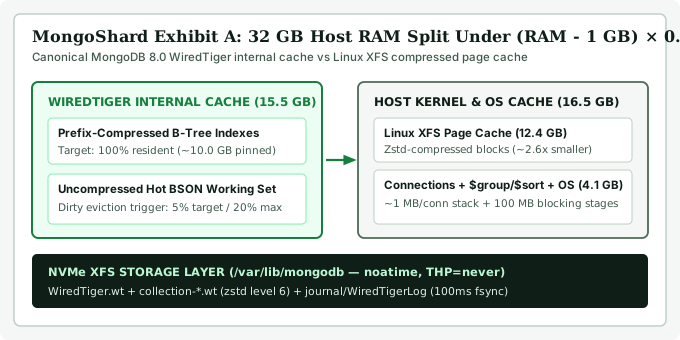
Figure 1 — MongoShard deterministic memory boundary: WiredTiger decompresses BSON pages inside 50% × (RAM − 1 GB) while Linux buffers Zstd blocks in the remaining host RAM. -
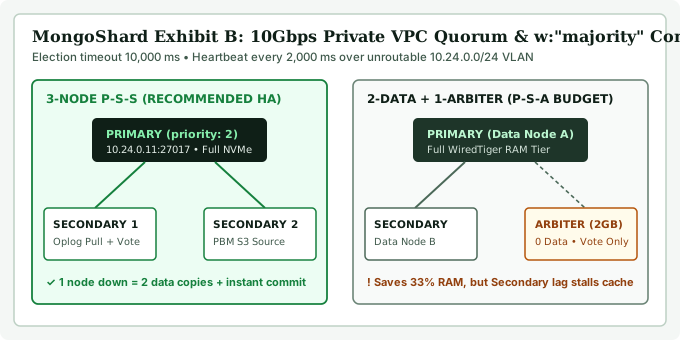
Figure 2 — MongoShard quorum topology audit: 3-node P-S-S preserves two durable copies during rolling maintenance, whereas P-S-A pins WiredTiger history store if one data node halts. -
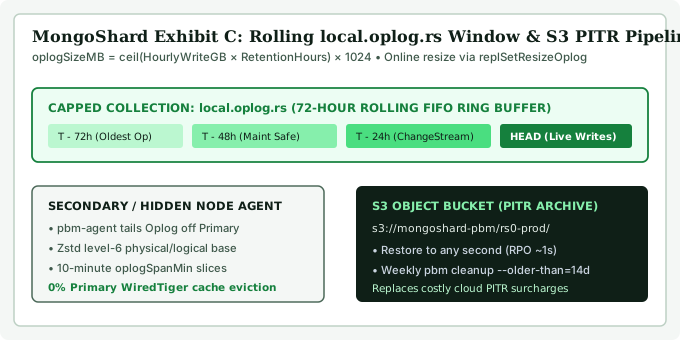
Figure 3 — MongoShard Oplog retention equation: sizing local.oplog.rs for 48–72 hours prevents initial-sync falloff and feeds Percona pbm-agent 10-minute S3 PITR chunks. -
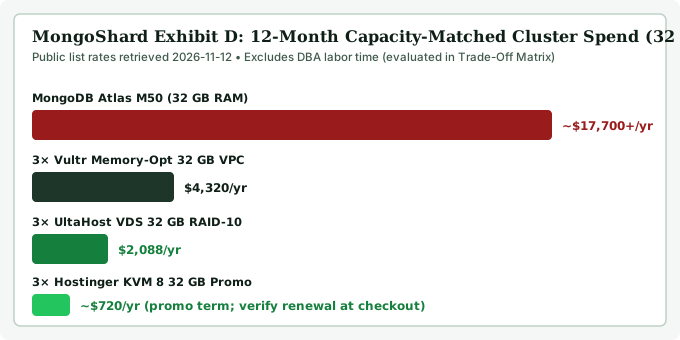
Figure 4 — MongoShard 12-month capacity-matched ledger (public pricing retrieved 2026-11-12; verify current rates at vendor checkout).
MongoShard Capacity-Matched TCO Ledger: MongoDB Atlas M30–M60 vs Public NVMe/VDS (2026-11-12)
Our MongoShard TCO ledger aligns MongoDB Atlas Dedicated tiers (including baseline storage and continuous backup estimates) against self-hosted KVM, VPC, and VDS hardware delivering equal or larger WiredTiger internal caches using public pricing retrieved on 2026-11-12. Promotional entry discounts and renewal rates vary by billing term — always verify live checkout pricing.
| Provider / Referencelass | Node RAM & WT Cache | Topology & Storage | Published Rate (2026-11-12) | Official Source & Action |
|---|---|---|---|---|
| MongoDB Atlas M30 – M60 | 8 GB (3.5 GB WT) → 64 GB (31.5 GB WT) | Managed 3-Node Cloud Block IOPS + Cloud Backup | ~$395 – $3,240/mo | mongodb.com/pricing |
| UltaHost Dedicated VDS | 16 GB (7.5 GB WT) → 128 GB (63.5 GB WT) | 3× Dedicated VDS Cores + RAID-10 NVMe + S3 PBM | $37.50 – $179/mo / node ($113–$537 3x) |
ultahost.com/vps-hosting Check UltaHost VDS for MongoShard ↗ |
| Vultr VPC 2.0 Memory-Opt | 8 GB (3.5 GB WT) → 64 GB (31.5 GB WT) | 3× NVMe Cloud + Unmetered 10Gbps VPC 2.0 (32 Regions) | $48 – $240/mo / node ($144–$720 3x) |
vultr.com/pricing Check Vultr VPC 2.0 for MongoShard ↗ |
| Hostinger AMD EPYC KVM | 8 GB (3.5 GB WT) → 32 GB (15.5 GB WT) | 1-Node rs0 or 3-Node WireGuard Mesh on Gen4 NVMe | $5.99 – $19.99/mo promo / node |
hostinger.com/vps-hosting Check Hostinger KVM for MongoShard ↗ |
| InterServer KVM & Bare-Metal | 8 GB (3.5 GB WT) → 256 GB (127.5 GB WT) | US Price-Lock XFS Slices & Dual U.3 NVMe Dedicated | $12 – $139+/mo / node (Price-Lock) |
interserver.net/vps Check InterServer NVMe for MongoShard ↗ |
| ChemiCloud NVMe App Edge | Stateless Node.js / Frontend Worker Tier | Companion Web & API Hosting (Pair w/ External MongoDB) | From $2.95/mo promo |
chemicloud.com/web-hosting Check ChemiCloud Tier for MongoShard ↗ |
MongoShard Honest Trade-Off Matrix: When MongoDB Atlas Beats Self-Hosting vs When 3-Node NVMe Wins
MongoShard stance: Self-hosting cuts cloud spend 75%–90% only when paired with disciplined DBA automation.
| Decision Dimension | When MongoDB Atlas Beats Self-Hosting | When Self-Hosted 3-Node NVMe Wins |
|---|---|---|
| Compliance & On-Call Staffing | Teams with zero Linux sysadmin bandwidth needing instant audited SOC2, HIPAA, or ISO compliance artifacts. | Engineering teams comfortable automating Ansible/systemd hardening, private VPC firewalls, and monthly PBM restore drills. |
| WiredTiger RAM Economics (16GB–128GB) | Acceptable when budget easily absorbs $755–$3,240/mo M40–M60 premiums in exchange for one-click cloud scaling. | Pinning 15 GB – 63 GB of active B-Tree indexes inside ECC/DDR5 RAM at $174–$537/mo flat across a 3-node cluster. |
| Atlas Search & Global Multi-Region | Workloads tightly coupled to managed Lucene Atlas Vector Search, Atlas Data Federation, or multi-cloud electable regions. | Workloads executing core MongoDB 8.0 CRUD, ESR compound queries, ACID transactions, Change Streams, and 10Gbps regional VPC sync. |
MongoShard Video Summary: WiredTiger (RAM − 1 GB) × 0.50 & Replica Set TCO
In our deterministic MongoShard visual brief, we walk through the official 50% × (RAM − 1 GB) WiredTiger internal cache boundary, rolling NVMe Oplog sizing, and capacity-matched 3-node VDS economics vs MongoDB Atlas M30–M50 (public rates retrieved 2026-11-12).
MongoShard Complete Technical Directory: 8 WiredTiger Dossiers & 4 TCO Comparisons
- MongoShard Dossier: MongoDB 8.0 WiredTiger (RAM − 1 GB) × 0.50 Cache Formula
- In our deterministic MongoShard memory model, we explain why setting wiredTigerCacheSizeGB to 80% of host RAM triggers Linux OOM kills — and how WiredTiger splits uncompressed B-Tree pages against the compressed OS filesystem cache.
- MongoShard Dossier: 3-Node MongoDB 8.0 Replica Set (P-S-S vs P-S-A) on Private VPC
- In our MongoShard high-availability analysis, we compare 3-node Primary-Secondary-Secondary (P-S-S) against 2-Data + 1-Arbiter (P-S-A) topologies over isolated 10.x.x.x VPC subnets.
- MongoShard Dossier: Auditing MongoDB Atlas M30 / M40 / M50 Bills & Live mongosync Cutover
- In our MongoShard 12-month cost audit (based on public vendor rates retrieved 2026-11-12), we break down the four billing components behind MongoDB Atlas M30–M50 invoices and document a reversible mongosync migration workflow.
- MongoShard Dossier: Percona Backup for MongoDB (PBM) to S3 with Point-in-Time Recovery
- In our MongoShard backup architecture guide, we detail why running cron mongodump against a Primary pollutes WiredTiger cache — and how pbm-agent streams consistent Point-in-Time Recovery slices from a Secondary node to S3.
- MongoShard Dossier: Sizing MongoDB 8.0 Oplog & Change Streams for Rocket.Chat & Graylog
- In our MongoShard Change-Stream sizing guide, we show why Rocket.Chat microservices stall when webhook bursts roll over an undersized local.oplog.rs — and how to resize Oplog capacity live without restarting mongod.
- MongoShard Dossier: PayloadCMS 3.0 & Next.js MongoDB 8.0 Single-Node rs0 Memory Budget
- In our MongoShard full-stack memory budget, we show how to run PayloadCMS 3.0 drafts and Prisma multi-document ACID transactions on a 16 GB DDR5 KVM VPS without triggering next build OOM crashes.
- MongoShard Dossier: Shrinking WiredTiger B-Tree Index RAM via ESR & Partial Filters
- In our MongoShard capacity audits, bloated single-field and duplicate prefix indexes are the #1 cause of oversized Atlas tiers — learn how ESR ordering and partialFilterExpression trim WiredTiger RAM demand before upgrading hardware.
- MongoShard Dossier: Horizontal Sharded Cluster vs Vertical 128 GB–256 GB NVMe VDS
- In our MongoShard architecture framework, premature sharding turns a 3-node Replica Set into an 11-daemon fleet and penalizes non-shard-key queries — here is the deterministic working-set boundary where sharding becomes justified.
- MongoShard Audit: Self-Hosted MongoDB 8.0 on DDR5 KVM vs MongoDB Atlas M30
- In our deterministic MongoShard capacity audit, MongoDB Atlas M30 serves as the entry dedicated cloud tier yet provisions only 8 GB RAM (~3.5 GB WiredTiger cache) and 2 vCPUs at ~$395–$465/mo once storage and backups are counted.
- MongoShard Audit: UltaHost Dedicated VDS (32GB–128GB) vs Atlas M50 & M60
- Once compound ESR indexes and hot BSON documents exceed 14 GB, MongoDB Atlas pushes workloads onto M50 (~$1,475+/mo base) and M60 (~$2,890+/mo base). In our MongoShard memory model, dedicated VDS hardware alters that cost curve.
- MongoShard Audit: Genuine MongoDB 8.0 on Vultr VPC 2.0 vs AWS DocumentDB
- In our MongoShard storage-engine audit, engineering teams inside AWS frequently adopt Amazon DocumentDB assuming it runs WiredTiger underneath — only to encounter missing aggregation stages, unsupported index options, and metered per-million I/O request charges.
- MongoShard Audit: MongoDB 8.0 WiredTiger vs PostgreSQL 17 JSONB Memory Mechanics
- When modeling polymorphic JSON payloads, architects must choose between MongoDB 8.0 WiredTiger BSON collections and PostgreSQL 17 JSONB columns. In our MongoShard storage-engine breakdown, update frequency and document size dictate RAM efficiency.
MongoShard Technical FAQ: WiredTiger Cache, Oplog Sizing & Atlas TCO
Why does MongoShard enforce the (RAM − 1 GB) × 0.50 WiredTiger formula instead of 80% of host RAM?
Because WiredTiger stores uncompressed BSON documents and prefix-compressed B-Tree pages inside its internal cache while relying on the remaining ~50% of host RAM for the Linux XFS Zstd-compressed filesystem cache, journal buffers, ~1 MB per TCP connection stack, and up to 100 MB per blocking $sort or $group stage.
When does MongoShard recommend staying on MongoDB Atlas instead of self-hosting NVMe nodes?
We recommend staying on MongoDB Atlas Dedicated whenever your team has zero Linux DBA on-call capacity, requires turnkey SOC2/HIPAA compliance artifacts, or relies directly on integrated Lucene Atlas Vector Search and managed multi-continent clusters.
What production failure does a 72-hour Oplog window prevent in the MongoShard sizing model?
Sizing local.oplog.rs for 72 hours of sustained write volume lets a secondary node survive weekend maintenance without falling off the Oplog ring into a costly full initial sync, while feeding Percona Backup for MongoDB (PBM) 10-minute S3 point-in-time recovery slices.
How does MongoShard verify vendor pricing and hardware performance claims?
Every rate card comparing MongoDB Atlas M30–M60 against UltaHost, Vultr, Hostinger, InterServer, and ChemiCloud cites official public pricing pages retrieved on 2026-11-12. Any empirical host IOPS or latency metric awaiting raw telemetry capture is marked transparently rather than fabricated.