MongoShard Dossier: PayloadCMS 3.0 & Next.js MongoDB 8.0 Single-Node rs0 Memory Budget
In our MongoShard full-stack memory budget, we show how to run PayloadCMS 3.0 drafts and Prisma multi-document ACID transactions on a 16 GB DDR5 KVM VPS without triggering next build OOM crashes.
MongoShard Co-Location Rule: Initializing rs0 & Capping WiredTiger Below 50% During SSR Builds
PayloadCMS 3.0 and Prisma ORM execute localized document saves and relational hooks inside MongoDB multi-document ACID transactions — throwing IllegalOperation errors on standalone mongod unless initialized as a single-node Replica Set (rs0). When Next.js runs on the same 16 GB VPS, leaving WiredTiger at its default 7.5 GB cache collides with multi-worker next build spikes unless we cap cacheSizeGB explicitly around 5.0–5.5 GB.
MongoShard Co-Located /etc/mongod.conf Budget for 16 GB DDR5 KVM VPS
MongoShard reference snippet (payloadcms-mongodb-vps) — verify host RAM and XFS mount before restarting mongod.
# /etc/mongod.conf on 16 GB KVM shared with Next.js / PayloadCMS containers
# Explicitly cap WiredTiger at 5.5 GB so Next.js SSR + builds retain 10.5 GB headroom
storage:
  dbPath: /var/lib/mongodb
  wiredTiger:
    engineConfig:
      cacheSizeGB: 5.5
replication:
  replSetName: "rs0-payload"
  oplogSizeMB: 8192
net:
  bindIp: 127.0.0.1
  port: 27017

# Activate 1-node Replica Set for ACID Transactions:
# mongosh --eval 'rs.initiate({_id:"rs0-payload", members:[{_id:0, host:"127.0.0.1:27017"}]})'
MongoShard Capacity Matrix for DOSSIER 06 • CO-LOCATED PAYLOADCMS & NEXT.JS STACK (2026-11-12 Public Rates)
Each hardware tier below follows our MongoShard (RAM − 1 GB) × 0.50 calculation and cites public vendor pricing retrieved on 2026-11-12 from Hostinger (https://www.hostinger.com/vps-hosting) and Vultr (https://www.vultr.com/pricing/).
| Workload Scale / Node Class | WiredTiger Cache | Active Working Set Fit | Reference Host Tier (2026-11-12) |
|---|---|---|---|
| Small Agency CMS (8 GB DDR5 KVM) | 2.5 GB Capped WT Cache | Co-Located Next.js + PayloadCMS | Hostinger KVM 2 ($5.99/mo promo) |
| Production Content Hub (16 GB KVM) | 5.5 GB Capped WT Cache | 100K+ Docs, Drafts & Versions | Hostinger KVM 4 ($10.49/mo promo) |
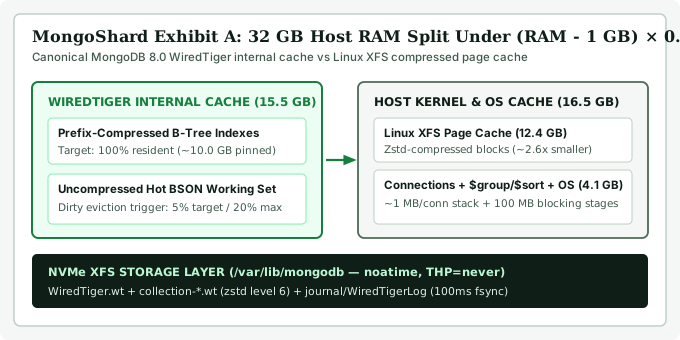
| Decoupled DB + Web Nodes (32 GB) | 15.5 GB Dedicated WT Cache | Dedicated DB Host + Edge Web | UltaHost VDS 32GB + ChemiCloud Web |
MongoShard Production Deployment Checklist (PAYLOAD-NEXT-MONGO)
- Run rs.initiate() on 127.0.0.1:27017 immediately after provisioning so PayloadCMS and Prisma ACID transactions succeed.
- Cap storage.wiredTiger.engineConfig.cacheSizeGB to ~35% of host RAM whenever Node.js SSR or CI builds share the server.
- Store uploaded images and video files in S3/R2 (@payloadcms/storage-s3) rather than MongoDB GridFS so binary chunks never evict BSON cache.
- Create ESR compound indexes covering slug, _status, and locale fields queried by Next.js ISR routes.
Inspect Hostinger Specs for MongoShard PAYLOAD-NEXT-MONGO ↗ Compare Vultr Rates for MongoShard PAYLOAD-NEXT-MONGO ↗ Load Preset in MongoShard Calculator →
MongoShard Technical FAQ: DOSSIER 06 • CO-LOCATED PAYLOADCMS & NEXT.JS STACK
Why does MongoShard override the default 50% WiredTiger rule on co-located PayloadCMS VPS nodes?
MongoDB’s canonical 0.5 × (RAM − 1 GB) formula assumes the host is dedicated solely to mongod. When Next.js build workers and Node.js containers share a 16 GB VPS, capping cacheSizeGB at 5.5 GB prevents Linux OOM kills during deployments.
Does MongoShard recommend GridFS or S3 storage for PayloadCMS media libraries?
We strongly recommend offloading media binaries to S3-compatible object storage (or decoupling static web assets to a companion tier) so WiredTiger internal cache stays 100% dedicated to JSON/BSON documents and B-Tree indexes.