MongoShard Audit: Genuine MongoDB 8.0 on Vultr VPC 2.0 vs AWS DocumentDB
In our MongoShard storage-engine audit, engineering teams inside AWS frequently adopt Amazon DocumentDB assuming it runs WiredTiger underneath — only to encounter missing aggregation stages, unsupported index options, and metered per-million I/O request charges.
MongoShard Architectural Verdict: When wire-level compatibility and flat monthly OpEx matter, we recommend running genuine MongoDB 8.0 or Percona Server across a 3-node Vultr VPC 2.0 subnet: you retain 100% native WiredTiger behavior, zero per-million I/O fees, and isolated 10Gbps private networking across 32 global regions.
MongoShard Side-by-Side Specification & 2026-11-12 Billing Ledger: VULTR MONGODB 8 VS DOCUMENTDB
| Architecture & Billing Metric | Vultr (MongoDB 8.0 / Percona) | AWS DocumentDB |
|---|---|---|
| Storage Engine Architecture | Genuine MongoDB 8.0 WiredTiger Engine | Wire-Protocol Emulation Over Aurora Storage |
| Query & Index Feature Parity | 100% Native MongoDB 8.0 (Time-Series, Partial, Collation) | Subset API Emulation (Documented Operator Gaps) |
| Read/Write I/O Request Metering | $0 Per-I/O Fees on Local NVMe Disks | $0.20+ Per Million I/O Requests (Standard Mode) |
| Private Replica Networking | Unmetered 10Gbps VPC 2.0 in 32 Global Regions | AWS VPC + Paid Cross-AZ & NAT Gateway Transfer |
| 3× 32GB HA Cluster Monthly Cost | $360/mo Flat Compute + S3 PBM (~$8/mo) | ~$1,150 – $1,850+/mo (Instances + Metered I/O) |
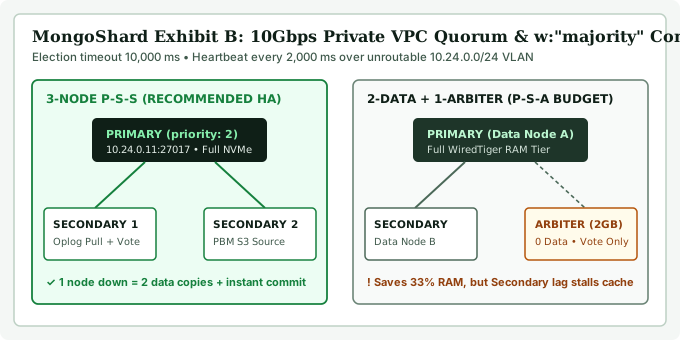
MongoShard Honest Trade-Off Table: When Each Architecture Wins (VULTR MONGODB 8 VS DOCUMENTDB)
| Production Workload Scenario | When the Alternative Platform Wins | When Self-Hosted MongoDB 8.0 Wins |
|---|---|---|
| Strict AWS IAM Role Integration & Zero Storage Volume Provisioning | AWS DocumentDB wins when enterprise policy mandates 100% AWS-managed services inside an existing AWS Organization with IAM authentication and auto-growing Aurora storage. | Vultr VPC 2.0 requires managing Linux XFS disk capacity alerts and running Percona pbm-agent for S3 backups. |
| Analytical Scans, Time-Series Collections & ORM Compatibility | Heavy collection scans or unindexed analytical pipelines on DocumentDB Standard drive steep per-million I/O surcharges (or force expensive I/O-Optimized instance rates). | Local NVMe disks on Vultr VPC 2.0 charge zero per-request I/O fees and execute genuine MongoDB 8.0 aggregation and time-series buckets natively. |
Key MongoShard Sizing Advantages on Vultr (VULTR MONGODB 8 VS DOCUMENTDB)
- Prevents late-stage production failures where Mongoose, Prisma, PayloadCMS, or Rocket.Chat queries hit unsupported DocumentDB emulation edge cases.
- Flat monthly NVMe instance pricing eliminates surprise invoices caused by background index builds, PBM backups, or analytical $lookup scans.
- Co-located Vultr S3-compatible Object Storage keeps 10-minute PBM Oplog PITR transfers inside the same regional data center.
Need 64 GB – 128 GB dedicated physical VDS cores at a lower flat monthly rate ($95–$179/node retrieved 2026-11-12)? Compare UltaHost High-RAM VDS.
Inspect Vultr Rates for MongoShard VULTR MONGODB 8 VS DOCUMENTDB ↗ Compare UltaHost Backup Option on MongoShard ↗ Model This Tier in MongoShard Sizer →
MongoShard Comparison FAQ: VULTR MONGODB 8 VS DOCUMENTDB
Why does MongoShard distinguish MongoDB 8.0 WiredTiger from AWS DocumentDB?
AWS DocumentDB emulates a MongoDB-compatible wire API atop Amazon’s distributed storage engine rather than running WiredTiger. Consequently, WiredTiger cache tuning, Zstd collection compression, and several MongoDB 8.0 operators behave differently or do not apply.
How does MongoShard isolate port 27017 on a 3-node Vultr VPC 2.0 cluster?
Bind net.bindIp strictly to 127.0.0.1 and each node’s private 10.x.x.x VPC 2.0 interface, attach a Vultr Cloud Firewall dropping all public TCP 27017 packets, and enforce 756-byte keyFile + TLS internal authentication.