MongoShard Dossier: 3-Node MongoDB 8.0 Replica Set (P-S-S vs P-S-A) on Private VPC
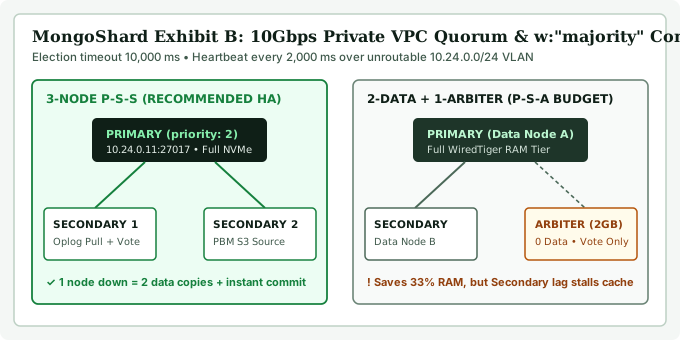
In our MongoShard high-availability analysis, we compare 3-node Primary-Secondary-Secondary (P-S-S) against 2-Data + 1-Arbiter (P-S-A) topologies over isolated 10.x.x.x VPC subnets.
MongoShard Quorum Audit: How P-S-A WriteConcern Traps Inflate WiredTiger History Store
Deploying a Primary + Secondary + Arbiter (P-S-A) cluster reduces server RAM spend by roughly 33%, yet we caution teams about its maintenance trade-off: if one data node goes offline while default writeConcern w:"majority" remains active, majority acknowledgment lags and WiredTiger must pin historical updates inside its cache history store. Across a 3-node P-S-S Replica Set on a private 10Gbps Vultr VPC 2.0 VLAN, any single node can reboot for Linux kernel updates while the remaining two data nodes satisfy w:"majority" commits cleanly.
MongoShard Keyfile Generation & rs.initiate() Private VPC Bootstrap
MongoShard reference snippet (three-node-replica-set-vpc) — verify host RAM and XFS mount before restarting mongod.
# Generate 756-byte shared cluster keyfile across all 3 nodes
openssl rand -base64 756 > /etc/mongodb-keyfile
chmod 400 /etc/mongodb-keyfile && chown mongodb:mongodb /etc/mongodb-keyfile

# mongosh — Initialize 3-Node P-S-S Replica Set over Private VPC (10.24.0.0/24)
rs.initiate({
  _id: "rs0-prod",
  members: [
    { _id: 0, host: "mongo-n1.vpc.internal:27017", priority: 2 },
    { _id: 1, host: "mongo-n2.vpc.internal:27017", priority: 1 },
    { _id: 2, host: "mongo-n3.vpc.internal:27017", priority: 1 }
  ]
});
MongoShard Capacity Matrix for DOSSIER 02 • REPLICA SET QUORUM & PRIVATE VPC (2026-11-12 Public Rates)
Each hardware tier below follows our MongoShard (RAM − 1 GB) × 0.50 calculation and cites public vendor pricing retrieved on 2026-11-12 from Vultr (https://www.vultr.com/pricing/) and UltaHost (https://ultahost.com/vps-hosting).
| Workload Scale / Node Class | WiredTiger Cache | Active Working Set Fit | Reference Host Tier (2026-11-12) |
|---|---|---|---|
| Budget Quorum (2-Data + Arbiter P-S-A) | 2× 7.5 GB + 2GB Voter | Auto-Election, 33% Lower RAM Cost | 2× Hostinger KVM 4 + KVM 1 (~$26/mo promo) |
| Production SaaS (3-Node P-S-S HA) | 3× 15.5 GB WT Cache | Durable w:majority + Rolling Patch | 3× Vultr VPC 32GB or UltaHost VDS 32GB |
| Analytics Isolation (3 P-S-S + 1 Hidden) | 3 Live + 1 Priority-0 Node | Dedicated BI / PBM Backup Member | Vultr Private VPC + Object Storage |
MongoShard Production Deployment Checklist (VPC-REPLICA-HA)
- Bind net.bindIp strictly to 127.0.0.1 and the unroutable VPC interface (10.24.0.x), dropping all public eth0 packets to port 27017.
- Declare internal split-horizon hostnames (mongo-n1.vpc.internal) inside rs.conf() rather than hardcoded IP addresses.
- Verify electionTimeoutMillis (default 10000 ms) aligns with your application driver serverSelectionTimeoutMS.
- Monitor WiredTiger history store utilization closely if you choose a P-S-A topology during secondary maintenance windows.
Inspect Vultr Specs for MongoShard VPC-REPLICA-HA ↗ Compare UltaHost Rates for MongoShard VPC-REPLICA-HA ↗ Load Preset in MongoShard Calculator →
MongoShard Technical FAQ: DOSSIER 02 • REPLICA SET QUORUM & PRIVATE VPC
When does MongoShard consider a 2-Data + 1-Arbiter (P-S-A) Replica Set acceptable?
We consider P-S-A reasonable for internal tools or cost-constrained staging/early SaaS clusters that need automatic primary failover without paying for a third high-RAM data node, provided operators understand that losing one data node leaves a single data copy and requires prompt repair.
Why does MongoShard emphasize private VPC 2.0 networking for 3-node Replica Sets?
In a 3-node Replica Set, every primary write replicates continuously across both secondaries via Oplog pulls. Routing port 27017 over an isolated 10Gbps private VLAN avoids public-internet TLS exposure and eliminates intra-region bandwidth surcharges on providers such as Vultr VPC 2.0.