MongoShard Audit: UltaHost Dedicated VDS (32GB–128GB) vs Atlas M50 & M60
Once compound ESR indexes and hot BSON documents exceed 14 GB, MongoDB Atlas pushes workloads onto M50 (~$1,475+/mo base) and M60 (~$2,890+/mo base). In our MongoShard memory model, dedicated VDS hardware alters that cost curve.
MongoShard Architectural Verdict: We recommend UltaHost Dedicated VDS for memory-intensive MongoDB 8.0 replica sets (32 GB to 128 GB ECC RAM per node) when predictable monthly OpEx matters: dedicated VDS CPU threads prevent hypervisor steal stalls during WiredTiger checkpoints, while 3-node P-S-S cluster spend drops from ~$1,680–$3,240/mo to $174–$285/mo (rates retrieved 2026-11-12).
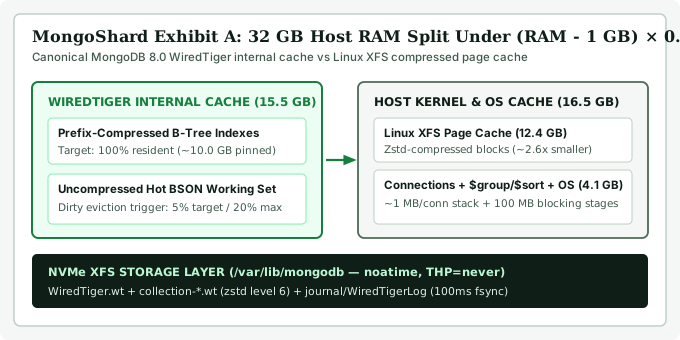
MongoShard Side-by-Side Specification & 2026-11-12 Billing Ledger: ULTAHOST VDS VS ATLAS M50/M60
| Architecture & Billing Metric | UltaHost (MongoDB 8.0 / Percona) | MongoDB Atlas M50/M60 |
|---|---|---|
| 3-Node 32GB HA (15.5GB WT Cache/Node) | $174/mo Total (3× Ulta VDS 32GB) | ~$1,680/mo (Atlas M50 + PITR + IOPS) |
| 3-Node 64GB HA (31.5GB WT Cache/Node) | $285/mo Total (3× Ulta VDS 64GB) | ~$3,240/mo (Atlas M60 + PITR + IOPS) |
| CPU Thread Scheduling | Dedicated Physical VDS Cores | Cloud Instance vCPUs on AWS/GCP/Azure |
| WiredTiger Checkpoint Storage | Local Enterprise RAID-10 NVMe | Provisioned Cloud Block IOPS Tiers |
| Vertical Ceiling Before Sharding | Up to 128 GB RAM (63.5 GB WT Cache/Node) | M60/M80 Escalation ($3,200 – $5,800+/mo) |
MongoShard Honest Trade-Off Table: When Each Architecture Wins (ULTAHOST VDS VS ATLAS M50/M60)
| Production Workload Scenario | When the Alternative Platform Wins | When Self-Hosted MongoDB 8.0 Wins |
|---|---|---|
| Multi-Region Active-Active Cloud Clusters & Atlas Vector Search | MongoDB Atlas M50/M60 wins when your architecture depends on managed multi-region electable nodes across AWS/GCP continents, Atlas Triggers, or integrated Lucene Atlas Vector Search. | Self-hosted VDS clusters require deploying separate search indices or MongoDB Community/Percona configurations and managing cross-region VPN latency manually. |
| Postponing Premature Sharding on 24 GB – 48 GB Working Sets | High per-GB RAM markups on M60/M80 tempt teams into premature sharding just to control instance bills. | Scaling a 3-node UltaHost VDS P-S-S set vertically to 64 GB or 128 GB per node keeps queries single-hop without mongos or CSRS complexity. |
Key MongoShard Sizing Advantages on UltaHost (ULTAHOST VDS VS ATLAS M50/M60)
- Dedicated VDS CPU scheduling prevents noisy-neighbor steal during 60-second WiredTiger checkpoints, protecting 10-second Replica Set election heartbeats.
- Vertical scaling up to 128 GB ECC RAM per node (63.5 GB WiredTiger cache) defers 11-daemon Sharded Cluster complexity for years.
- Reduces annual 3-node HA infrastructure spend by roughly $18,000 to $35,000 per cluster based on 2026-11-12 public rate cards.
Operating strictly inside US East or US West and prefer non-virtualized 128 GB – 256 GB Ryzen/Xeon bare-metal servers with locked monthly renewal pricing? Compare InterServer Dedicated.
Inspect UltaHost Rates for MongoShard ULTAHOST VDS VS ATLAS M50/M60 ↗ Compare InterServer Backup Option on MongoShard ↗ Model This Tier in MongoShard Sizer →
MongoShard Comparison FAQ: ULTAHOST VDS VS ATLAS M50/M60
How much WiredTiger cache does MongoShard allocate on a 64GB UltaHost VDS node?
Applying storage.wiredTiger.engineConfig.cacheSizeGB = 0.5 * (64 - 1) yields exactly 31.5 GB of uncompressed WiredTiger internal cache plus ~26 GB of Linux XFS Zstd compressed filesystem cache.
Why does CPU steal hurt MongoDB Replica Sets in the MongoShard sizing model?
Every 60 seconds WiredTiger flushes dirty pages and compresses Zstd blocks. On oversold shared vCPUs, CPU steal delays replication heartbeats past electionTimeoutMillis (10,000 ms), causing disruptive primary stepdowns.