MongoShard Dossier: Sizing MongoDB 8.0 Oplog & Change Streams for Rocket.Chat & Graylog
In our MongoShard Change-Stream sizing guide, we show why Rocket.Chat microservices stall when webhook bursts roll over an undersized local.oplog.rs — and how to resize Oplog capacity live without restarting mongod.
MongoShard Bottleneck Model: Change-Stream Fan-Out & Oplog Ring Rollover
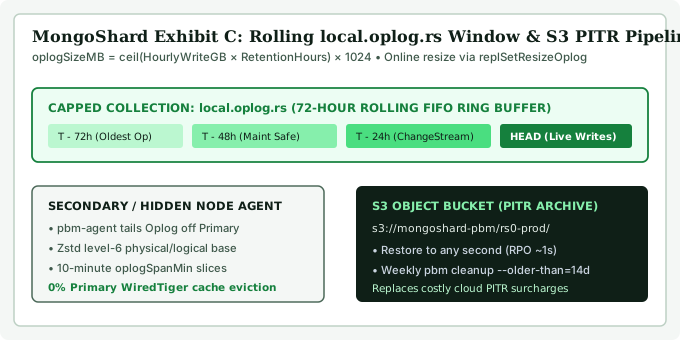
Real-time collaboration platforms like Rocket.Chat spawn multiple presence, stream-hub, and WebSocket worker containers that tail MongoDB Change Streams concurrently. If local.oplog.rs holds only a few hours of write volume during automated bot or webhook bursts, tailing cursors lose their resume token and trigger expensive re-queries while noisy-neighbor CPU steal delays Oplog visibility.
MongoShard Live replSetResizeOplog Command & Production URI Template
MongoShard reference snippet (rocketchat-mongodb-oplog) — verify host RAM and XFS mount before restarting mongod.
// 1. Live-resize MongoDB 8.0 Oplog to 40 GB (40960 MB) in mongosh with zero restart
db.adminCommand({ replSetResizeOplog: 1, size: Double(40960), minRetentionHours: 48 })

// 2. Inspect actual Oplog GB capacity & observed retention window
rs.printReplicationInfo()

# 3. Rocket.Chat Production Replica Set Connection Strings
MONGO_URL="mongodb://rc_app:PASS@10.24.0.11:27017,10.24.0.12:27017,10.24.0.13:27017/rocketchat?replicaSet=rs0-prod&readPreference=primaryPreferred&w=majority"
MONGO_OPLOG_URL="mongodb://rc_oplog:PASS@10.24.0.11:27017,10.24.0.12:27017,10.24.0.13:27017/local?replicaSet=rs0-prod&authSource=admin"
MongoShard Capacity Matrix for DOSSIER 05 • CHANGE STREAM & OPLOG RING SIZING (2026-11-12 Public Rates)
Each hardware tier below follows our MongoShard (RAM − 1 GB) × 0.50 calculation and cites public vendor pricing retrieved on 2026-11-12 from UltaHost (https://ultahost.com/vps-hosting) and Vultr (https://www.vultr.com/pricing/).
| Workload Scale / Node Class | WiredTiger Cache | Active Working Set Fit | Reference Host Tier (2026-11-12) |
|---|---|---|---|
| Team Workspace (~500 Active Seats) | 7.5 GB WT Cache (16GB Node) | 20 GB Oplog (1-Node rs0 / P-S-A) | Hostinger KVM 4 ($10.49/mo promo) |
| Organization Hub (~2,500 Seats) | 15.5 GB WT Cache (32GB Node) | 50 GB Oplog (3-Node P-S-S) | UltaHost VDS 32GB ($58/mo/node) |
| High-Volume Chat + Graylog Meta | 31.5 GB WT Cache (64GB Node) | 120 GB Oplog + Dedicated Cores | UltaHost VDS 64GB or Vultr VPC |
MongoShard Production Deployment Checklist (ROCKETCHAT-OPLOG)
- Initialize a Replica Set (even on single-host setups) because Rocket.Chat and modern Change Stream consumers require local.oplog.rs.
- Use replSetResizeOplog online to maintain a minimum 48–72 hour retention buffer above peak bot/webhook write rates.
- Enforce TTL indexes on transient session, typing-presence, and webhook delivery collections to keep WiredTiger lean.
- Isolate OpenSearch/Elasticsearch JVM heaps onto separate servers so Graylog log indexing never starves MongoDB WiredTiger RAM.
Inspect UltaHost Specs for MongoShard ROCKETCHAT-OPLOG ↗ Compare Vultr Rates for MongoShard ROCKETCHAT-OPLOG ↗ Load Preset in MongoShard Calculator →
MongoShard Technical FAQ: DOSSIER 05 • CHANGE STREAM & OPLOG RING SIZING
Can operators apply MongoShard Oplog size increases on a live Rocket.Chat cluster without downtime?
Yes. MongoDB 8.0 supports db.adminCommand({ replSetResizeOplog: 1, size: Double(MB) }) dynamically on each Replica Set member with zero service restart or WebSocket disconnection.
Why does MongoShard advise separating Graylog OpenSearch nodes from MongoDB WiredTiger?
OpenSearch locks up to 31 GB in JVM heap and aggressively consumes the remaining Linux page cache for Lucene segments. Co-locating both engines without hard RAM caps starves WiredTiger and triggers swap thrashing.